Horror 666 Font Review: A PUA-Encoded Display Type for Dark Aesthetics
In the landscape of digital typography, finding a display font that balances theatricality with functional usability is a persistent challenge. Many typefaces in the horror and thriller genres lean too heavily into caricature, sacrificing legibility for shock value. Horror 666 emerges as a notable exception within this niche. It is a cool, creepy, and dramatic display font designed to evoke tension without completely obscuring the message. For designers, marketers, and content creators working within the entertainment, gaming, or dark-themed lifestyle sectors, understanding the specific mechanics and applications of this typeface is essential before integrating it into a project.
This review evaluates Horror 666 not merely as a visual asset, but as a practical tool. We will examine its technical foundation, specifically its Private Use Area (PUA) encoding, analyze its aesthetic strengths, and determine where it fits within professional workflows. The goal is to provide an objective assessment of whether this font offers sufficient versatility and reliability for serious creative work.
Understanding the Technical Foundation: PUA Encoding
The most significant technical feature of Horror 666 is its reliance on Private Use Area (PUA) encoding. To understand why this matters, one must look at how standard fonts operate versus how specialized display fonts are constructed. Standard Unicode encoding maps characters to specific code points assigned by the Unicode Consortium. However, many decorative glyphs, swashes, ligatures, and alternate forms do not have official Unicode assignments. Instead, font developers often place these extra characters in the PUA section of the character map—a reserved space intended for private use.
For the end-user, this has distinct implications. On one hand, PUA encoding allows the designer to include a vast array of stylistic alternates, ornamental borders, and thematic symbols that would otherwise be impossible to access via a standard keyboard. For Horror 666, this means you can access all of the glyphs and swashes with ease, provided you know how to navigate the font’s internal character map. This accessibility is a major strength, offering creative freedom that goes beyond simple letter substitution.
On the other hand, PUA encoding presents a workflow hurdle. Because these characters are not mapped to standard keys, inserting them requires manual selection through font utilities, OpenType features, or copy-pasting from a glyph panel. This can slow down rapid design processes if the user is not familiar with the font’s specific interface. Therefore, while the expressive potential is high, the initial learning curve is steeper than that of a standard system font. Professionals who prioritize speed over bespoke typographic detailing may find this friction noticeable, whereas those focused on high-fidelity graphic design will likely appreciate the depth of available assets.
Aesthetic Characteristics and Visual Impact
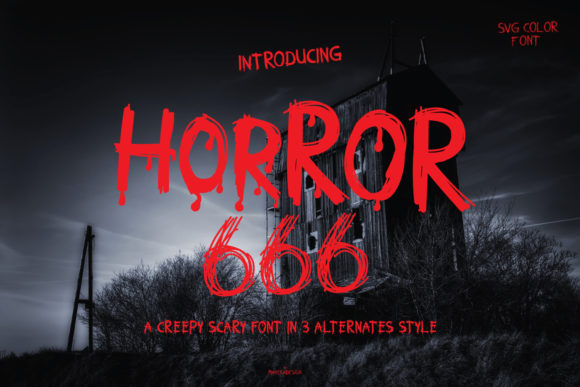
Visually, Horror 666 is defined by its dramatic presence. The typeface does not attempt to whisper; it commands attention. The letterforms are characterized by sharp angles, irregular spacing, and a distressed texture that suggests decay, violence, or supernatural unease. The "cool" factor mentioned in its description stems from its modern interpretation of classic horror tropes. Unlike older horror fonts that rely on dripping blood or overly gothic blackletter styles, Horror 666 feels more contemporary, aligning better with modern streaming service branding, indie game aesthetics, and alternative fashion marketing.
The dramatic quality of the font is achieved through high contrast between thick and thin strokes in certain glyphs, creating a jagged, unstable rhythm when set in paragraphs. This makes it unsuitable for body text but highly effective for headlines, titles, and logo design. The creepiness is subtle yet pervasive; it relies on asymmetry and slight distortions rather than overt gore, which allows it to remain usable in contexts where explicit imagery might be restricted.
When evaluating the font’s effectiveness, it is important to note that its impact is context-dependent. In isolation, a single word in Horror 666 looks striking. However, when used in larger compositions, the aggressive nature of the letters can compete with imagery and other design elements. Successful application requires restraint. The font works best when given ample negative space, allowing the intricate details of each character to breathe. Overcrowding the text diminishes its power and reduces readability to near zero.
Practical Applications and Industry Fit
Determining who benefits most from Horror 666 requires looking at specific industries and use cases. This is not a general-purpose font. Its utility is concentrated in sectors where atmosphere and genre signaling are paramount.
- Gaming and Esports: Indie game developers, particularly those working in survival horror, psychological thriller, or dark fantasy genres, can leverage this font for UI elements, quest titles, and promotional banners. The PUA-encoded swashes can serve as decorative dividers or iconography within game interfaces.
- Entertainment Marketing: Movie posters, trailer teasers, and event flyers for horror films or haunted attractions benefit from the immediate genre recognition the font provides. Marketers can use it to create urgency and fear, tapping into the emotional response required to drive ticket sales or attendance.
- Music and Merchandise: Bands in the metal, industrial, or punk genres often utilize dark aesthetics for album art, tour posters, and merchandise. Horror 666 offers a cohesive visual language that aligns with these musical subcultures, providing a professional finish to DIY designs.
- Publishing and Blogging: While less common for long-form text, bloggers and publishers covering true crime, paranormal investigations, or speculative fiction can use this font for pull quotes, chapter headers, and sidebar highlights. It breaks up monotony and reinforces the thematic tone of the content.
For small business owners in the hospitality industry, such as escape rooms, haunted houses, or themed restaurants, this font can be a valuable asset for signage and menu design. It helps establish an immersive environment from the moment a customer engages with the brand visually. However, caution is advised in corporate or B2B contexts where trust and clarity are prioritized over drama. Using Horror 666 in a financial report or a medical brochure would likely undermine credibility and confuse the audience.
Evaluating Quality, Usability, and Long-Term Value
From a quality standpoint, Horror 666 demonstrates consistent rendering across different sizes and mediums. The vector paths appear clean, minimizing the risk of pixelation when scaled for large-format printing. However, the reliance on PUA encoding means that consistency depends heavily on the software being used. Modern design tools like Adobe Illustrator, Photoshop, and Affinity Designer handle PUA fonts well, offering robust glyph panels. Older or web-based editors may struggle to display the full range of characters, potentially leading to missing glyphs or fallback issues.
Usability is further influenced by licensing and distribution. As with many independent typefaces, it is crucial to verify the license terms before commercial use. Some PUA-encoded fonts come with restrictions on embedding in PDFs or web pages due to the non-standard nature of the characters. Designers should always read the End User License Agreement (EULA) to ensure compliance, especially when distributing files to clients or publishing online.
The long-term value of Horror 666 lies in its specificity. It is a niche tool that solves a specific problem: how to convey horror and drama with modern elegance. It is not a versatile workhorse font that can adapt to multiple tones. Therefore, its value is high for projects that require this exact aesthetic, but low for generalists. If a designer needs a font that can shift from playful to serious, Horror 666 will not fulfill that role. But if the goal is to create a singular, memorable impression within the horror spectrum, it delivers strong results.
Potential Limitations and Considerations
No font is without limitations. One potential drawback of Horror 666 is its limited character set flexibility. While the swashes and alternates add flavor, the core alphabet may lack some of the refined nuances found in premium, widely distributed type families. Additionally, because it is a display font, kerning pairs may not be perfectly optimized for all combinations. Users may need to manually adjust spacing to achieve a polished look, particularly when mixing different glyphs from the PUA set.
Another consideration is audience perception. Horror is a polarizing genre. Using this font signals to the viewer that the content is intense, scary, or unconventional. For brands trying to appeal to a broad, family-friendly demographic, this signal can be alienating. It is vital to align the font choice with the brand’s overall voice and target audience expectations. Misalignment can lead to confusion or unintended negative associations.
Final Assessment
Horror 666 stands out as a competent and atmospheric display font for professionals working in dark-themed creative fields. Its PUA encoding unlocks a rich library of decorative elements, offering significant creative potential for those willing to navigate the slightly more complex workflow. The font’s cool, creepy, and dramatic style is executed with enough sophistication to avoid cliché, making it suitable for modern interpretations of horror in gaming, marketing, and publishing.
However, it is not a universal solution. Its utility is strictly bounded by its genre-specific aesthetic and technical requirements. Designers should evaluate their project needs carefully: if the goal is to evoke dread, mystery, or intensity with a contemporary edge, Horror 666 is a strong candidate. If the need is for broad readability, neutrality, or multi-genre flexibility, other options will serve better. Ultimately, its value is determined by how well it integrates into a cohesive visual strategy, enhancing the narrative rather than distracting from it.